Article
What a five-generation workforce case study reveals about what managers actually need to do
Key takeaways
- Generational labels feel like pattern recognition, but they replace the conversation you should actually be having with your team.
- Engagement dropped across every generation last year. The common variable wasn’t age. It was whether people felt connected to their manager.
- The teams that improved stopped asking “what does each generation need?” and started asking “what does this specific person need right now?”
- Small behaviors repeated consistently matter more than generational programming: better questions in 1:1s, transparent decision-making, specific recognition.
- People don’t feel seen through org-wide initiatives. They feel seen when their manager notices what’s actually happening in the room.
The engagement survey results are up on the screen. Someone is clicking through the slides. The numbers dropped again. There’s a quiet moment where everyone in the room is thinking the same thing: we need to figure out what’s going wrong.
Then someone says it: “Maybe it’s a generational thing.”
And suddenly the room has a theory. The conversation shifts to what each generation wants, what they value, how they communicate differently. It feels productive because it feels like pattern recognition.
Watch what happens next. Someone mentions Gen Z’s communication preferences. Someone else brings up Boomers’ work ethic. People start nodding. The problem that felt overwhelming two minutes ago now has a shape. A vocabulary. A framework that everyone recognizes from the last conference keynote or LinkedIn article.
Generational explanations are appealing because they turn a management problem into a knowledge problem. If engagement is dropping because of generational differences, the solution is learning more about those differences. That feels solvable. It’s less uncomfortable than asking whether the issue is how managers are actually showing up.
But what if that pattern is a distraction?
Gallup’s 2025 data showed employee engagement at 31%, with declines hitting every generation. The teams struggling the most aren’t all young or all experienced. They’re mixed. So the question isn’t what each generation needs. It’s what a multi-generational workforce actually needs from its managers.
The generational label trap
Generational categories feel useful because they give managers a way to organize what they’re seeing. Someone pushes back on a process: “That’s so Gen X.” Someone asks about remote work: “Classic millennial question.” The labels create the illusion of pattern recognition.
But here’s what actually happens. When managers default to generational assumptions, they stop listening to individuals and start managing stereotypes. The shortcut replaces the conversation.
The Stepstone Group’s 2023 research found that the classification of generations lacks empirical foundation. The categories we treat as explanatory don’t actually predict workplace behavior. They just feel like they do.
Brieane Olson, CEO of PACSUN, put it simply: “People want to feel seen and valued, and to feel like they matter beyond the task list.” That isn’t generational. It’s human.
The instinct to segment by age group leads to programming (mentorship cohorts, reverse-mentoring pilots, generational workshops) that addresses labels rather than the actual dynamics on the team. The real driver of disconnection isn’t generational — research on workplace loneliness and its effects on productivity shows that isolation hits every age group equally.
If generational labels aren’t the answer, what does the engagement data actually point to?
What the engagement data actually shows
When Gallup measured engagement in 2025, they found something that should have ended the generational debate. Engagement dropped across every generation. Gen Z and younger millennials fell 8 points. Older millennials dropped 9. Gen X moved from 35% to 31%. The pattern wasn’t generational. It was universal.
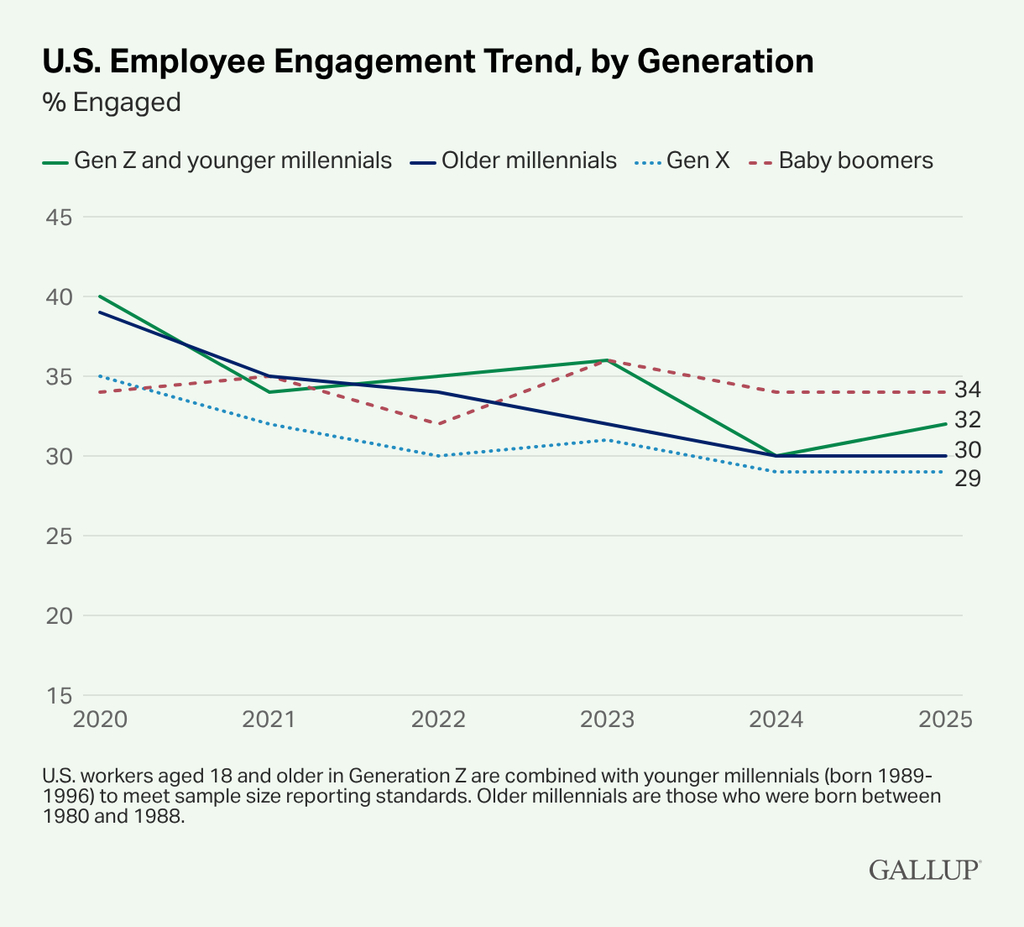
The most telling signal isn’t in the aggregate numbers. It’s in what people say they’re missing. Only 41% of Gen Z employees say someone at work cares about them (down from 54% in 2020). That’s not a Gen Z story. It’s the leading edge of what’s happening everywhere.
If engagement is declining across every age group, what’s the common variable? Gallup found that managers account for 70% of the variance in team engagement. When people feel connected to their manager, they engage. When they don’t, engagement drops. Research shows that connected teams outperform others precisely because of this dynamic.
The fix isn’t a program. It’s a behavior shift. When managers change everyday behaviors, engagement improves because people feel more supported, recognized, and aligned. That shift happens through small, repeated moments, not through org-wide action plans.
So what does this look like when a real organization acts on it?
What a five-generation workforce case study reveals
A mid-market company with roughly 600 employees and five generations on staff had spent two years running generational engagement programming. Mentorship cohorts. Reverse-mentoring pilots. Generational preference workshops. When the engagement scores came back, nothing had moved.
Someone asked: “What if we’re looking at the wrong pattern?”
They pulled up the team-level data. The lowest-scoring teams weren’t all young. The highest-scoring teams weren’t all experienced. The declines weren’t concentrated in one age group. They were everywhere.
That’s when they started paying attention to what the struggling teams had in common. It wasn’t age. It was whether people felt supported when they hit a roadblock. Whether they understood why decisions were being made. Whether anyone noticed when they did something well.
Instead of asking “what does each generation need?” leaders started asking “what does this specific team need right now?”
Here’s what they found. The teams with the highest engagement had managers who could name what each person was working on and what was getting in their way. The teams with the lowest engagement had managers who could describe their team’s demographics but couldn’t tell you what made last Tuesday hard for anyone on the team.
Engagement wasn’t declining because five generations couldn’t work together. It was declining because managers had stopped paying attention to the signals that mattered. They were managing categories instead of people.
Within two quarters of shifting focus to team-level behaviors, engagement scores moved. The gains weren’t age-specific. Teams with wide generational spreads improved at the same rate as homogeneous teams. The variable was manager behavior, not team composition.
Five things managers can do this week
- Ask one question in your next 1:1 that you’ve never asked before. Try: “What’s something about your work right now that I might not know about?” The goal is to signal that you’re paying attention to the person, not just the project. This works whether your direct report is 24 or 54.
- End every Friday with a five-minute conversation about what changed this week. Not a status update. A conversation about what shifted: what got harder, what got easier, what surprised them. This helps managers spot energy drains before they become disengagement.
- Open your next team meeting by stating one decision and why you made it. Transparency doesn’t require a town hall. It requires a manager who narrates their thinking out loud. When people understand the “why,” they stop guessing and start aligning.
- Name one specific contribution from a team member in a setting where others can hear it. Not a Slack emoji. A sentence: “Jess caught a data issue last Tuesday that saved us a week of rework.” Specificity is what makes recognition land.
- In your next meeting, say “I don’t know” or “I was wrong” about something real. Psychological safety starts with the manager. Microsoft’s 2026 research found that managers who created psychological safety saw 20-point higher AI readiness on their teams. Safety isn’t just about feelings. It’s about performance. Leaders who ignore the connection between safety and readiness risk treating employee disengagement as an operational risk that compounds over time.
For a broader look at how these behaviors connect to holistic team health, see these strategies to improve employee well-being.
How to know if it’s working
The answer isn’t in a dashboard. It’s in the moments you notice when you’re paying attention.
Someone who usually stays quiet in meetings starts offering ideas. A 1:1 that used to be a status update turns into a real conversation. Two team members solve a problem together without waiting for you to step in. Someone asks a question they wouldn’t have asked three months ago.
These signals show up before any survey captures them. Surveys measure engagement. They don’t improve it. The behaviors in the previous section are what improve it. If you’re doing the work, you’ll see the change before any score confirms it.
The real question isn’t about generations
Think back to that conference room. The survey results on the screen. The moment when someone said “maybe it’s a generational thing” and the room relaxed because it finally had a pattern to work with.
The teams that improved didn’t crack the code on generational differences. They stopped asking “what does each generation need?” and started asking “what does this specific person need right now?”
Engagement doesn’t decline because of generational friction. It declines when people stop feeling seen. That’s not a generation story. It’s a human one.
Every team is a multi-generational workforce now. The managers who build the strongest teams won’t be the ones who memorized what each generation supposedly wants. They’ll be the ones who pay attention to what’s actually happening in the room.
Frequently asked questions
What is the best way to manage a multigenerational workforce?
The best approach isn’t generational management. It’s team-level management. Focus on consistent behaviors (regular check-ins, specific recognition, transparent decision-making, psychological safety) rather than age-based programming.
Do generational differences actually affect team performance?
Life-stage differences are real. Someone early in their career has different needs than someone near retirement. But what drives performance is the same across ages: feeling supported, recognized, aligned, safe, and energized.
How do you build team culture across different generations?
Culture is built through consistent, small behaviors repeated by managers. Gallup found that employees connected to culture are 4x more likely to be engaged. That connection happens at the team level through shared rituals: weekly check-ins, recognition moments, and transparent decision-making. Research also shows that workplace friendships drive engagement and retention, reinforcing the importance of human connection over generational programming.
What role do managers play in multigenerational team engagement?
A manager’s job isn’t to become an expert on generational theory. It’s to pay attention to their people and respond to what they actually need. Everyday behaviors (better questions, recognizing contributions, creating safety) drive engagement more than any top-down initiative.