Article
Employee engagement indicators:
The five signals your annual survey misses
Key takeaways:
- Your annual survey tells you what already happened. The silence in Monday’s standup tells you what’s coming next.
- Engagement lives in the space between meetings, in who speaks up and who helps without being asked, not in the data you collect once a year.
- Managers shape 70% of team engagement, which means the most important signals show up at the team level, not in organization-wide dashboards.
- The gap between survey cycles is where engagement is actually built or lost, and it’s the gap most organizations ignore completely.
- A manager who notices when someone’s energy shifts will do more for engagement than any company-wide action plan.
The Monday morning silence
Your team used to riff on ideas before standup even started. Someone would share a weekend story, someone else would build on yesterday’s brainstorm, and by the time the meeting officially began, half the work was already unblocked. Now the call opens to silence. Cameras off. Everyone waiting for someone else to speak first.
You notice the shift but can’t point to a single event that explains it. No one quit. No major restructure happened. The last engagement survey came back within normal range. On paper, everything looks fine.
Here’s what most people miss: disengagement doesn’t announce itself. It doesn’t show up as a number that suddenly drops or a person who dramatically quits. It shows up as a team that used to finish each other’s sentences now finishing meetings as quickly as possible. It’s the absence of something that used to be there: energy, momentum, the informal collaboration that made hard work feel lighter.
The employee engagement indicators that matter most aren’t hiding in your survey data. They’re happening right now, in the space between meetings, in the energy (or absence of it) that carries your team through the day. What if the most important signs of employee engagement aren’t in your annual survey at all? What if they’re in the ordinary moments you’re already witnessing but haven’t learned to read yet?
Why annual surveys measure the past, not the future
An HR leader receives the annual engagement survey results in March showing strong scores across the board. By June, three top performers have resigned. The survey said everything was fine.
This disconnect happens because surveys capture a moment in time, not a trend. The employee engagement metrics most companies track (turnover rate, absenteeism, eNPS) are lagging indicators: they confirm disengagement after it has already taken root. By the time these numbers move, the damage is done.
Surveys measure engagement. They do not improve it. Improvement happens through consistent, visible actions between survey cycles, in the daily interactions where engagement is actually built or lost.
55% of workers believe their employer overestimates how healthy the workplace actually is (APA, 2023). That gap between what surveys capture and what employees experience daily is where disengagement builds momentum. With 80% of the global workforce either not engaged or actively disengaged (Gallup, 2026), costing an estimated $10 trillion annually, the problem isn’t that organizations don’t measure engagement. It’s that they’re measuring the wrong things at the wrong time.
Leading vs. lagging indicators: a distinction that changes everything
Imagine your team’s best designer gives two weeks’ notice. You pull the last engagement survey. Her scores were average, nothing alarming. Then you remember: three weeks ago, she stopped contributing in design reviews. Two weeks before that, she started declining optional team events. The data said everything was fine. The behavior was telling a different story the whole time.
Here’s what makes this so frustrating: you saw it happening. You just didn’t know you were supposed to be looking. The survey measured her satisfaction at a single point in time. But engagement doesn’t collapse in a moment. It erodes in a series of small withdrawals that happen in plain sight, weeks or months before anyone thinks to ask if something’s wrong.
There are two kinds of signals in every workplace. Some tell you what already happened: someone quit, absenteeism spiked, a survey score dropped. You can measure these precisely, but only after the damage is done. Then there are the signals that tell you what’s coming: the person who used to speak up goes quiet, teammates stop helping each other without being asked, energy drains from interactions that used to create momentum. These signals are harder to quantify, but they give you something more valuable than data. They give you time.
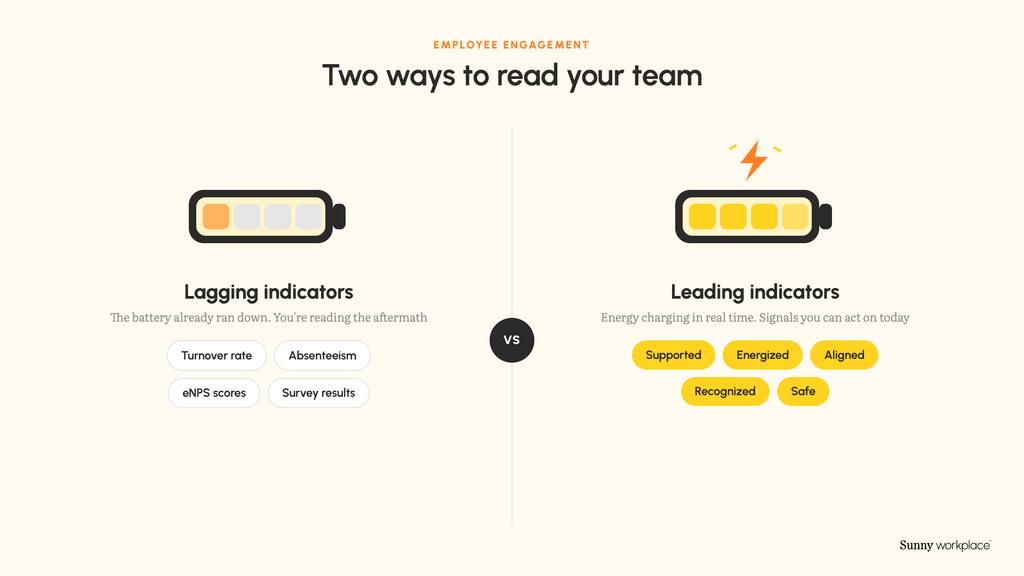
Most organizations build their entire engagement strategy around the first type of signal—what’s already happened—and then wonder why they’re always reacting instead of preventing. The shift isn’t about collecting more data. It’s about trusting what you can already see. Stop asking “how engaged are our people?” and start asking “what behaviors predict where engagement is headed?” One question looks backward. The other gives you a chance to do something before the best people on your team start updating their LinkedIn profiles.
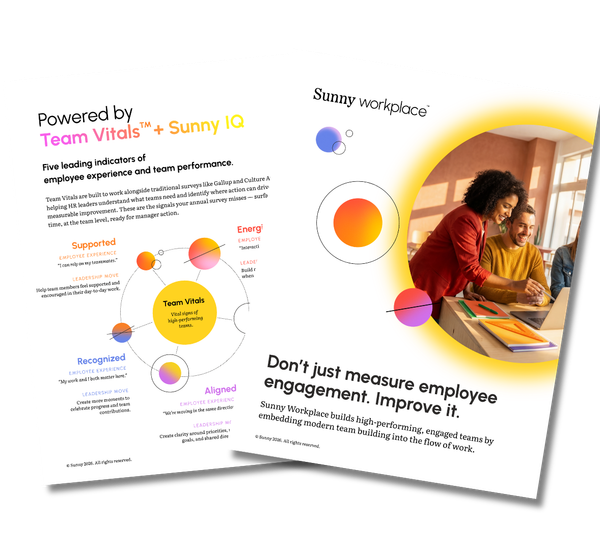
Five leading indicators that reveal engagement before your survey does
You’ve probably noticed these patterns already: the teammate who used to volunteer ideas now stays quiet, the team that used to help each other without asking now works in silos. These aren’t random observations. They’re signals.
Engagement shifts happen in real time, in ordinary team interactions that surveys won’t capture for months. Managers account for 70% of the variance in team engagement (Gallup), which means the behavioral signals at the team level give you more leverage than any organization-wide dashboard.
1. Supported: “I can rely on my teammates”
A product team is mid-sprint when an engineer hits a blocker at 3 p.m. Within 20 minutes, two teammates have jumped into a Slack thread offering solutions. No manager intervened. No process triggered it. The team just responded because helping is how they work.
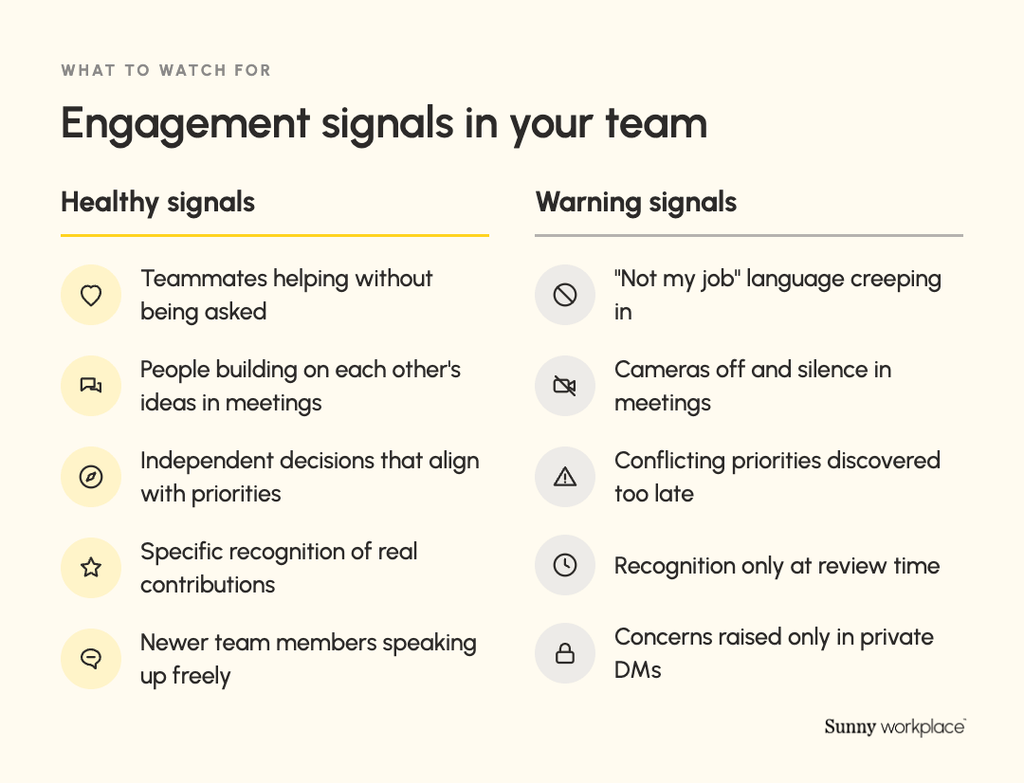
When people feel supported, they take on harder problems, ask for help earlier, and recover faster from setbacks. Observable signals: teammates volunteering help without being asked, people flagging blockers early, workload shared without resentment. Warning signals: people hoarding work, reluctance to ask for help, “not my job” language creeping into conversations.
Employees who feel connected to their organization’s culture are 4.3x as likely to be engaged (Gallup). Support is one of the strongest cultural connectors, built through daily interactions, not annual programs. Research shows that connected teams outperform others specifically because this kind of mutual support compounds over time.
2. Energized: “Interactions leave me with more energy”
You know the meeting: the weekly team sync where half the group has cameras off, no one speaks unless called on, and everyone leaves more drained than when they started. Compare that to the team whose syncs regularly run over because people are building on each other’s ideas. Same structure. Completely different energy.
Energy is contagious and observable. Teams where interactions create energy show stronger engagement over time. This isn’t about personality. It’s about whether people leave conversations feeling like something moved forward, the same dynamic that makes workplace friendships drive engagement and retention. 92% of workers say they want to work for an organization that values their well-being (APA, 2023). Energy is a daily well-being signal that surveys rarely capture.
Observable signals: people building on ideas, voluntary collaboration, problems brought to the group. Warning signals: meetings that feel like obligations, post-meeting silence where discussion used to continue.
3. Aligned: “We’re pulling in the same direction”
A common management mistake: a leader assumes that because the team sat through the strategy presentation, everyone understands the priorities. Three weeks later, half the team is working on conflicting goals. No one is disengaged in the traditional sense. They’re just pulling in different directions.
Alignment doesn’t mean agreement on everything. It means the team shares a clear understanding of what matters most and why. When alignment is strong, people make independent decisions consistent with team priorities and trade-offs are understood, not debated every week.
Misalignment creates invisible friction that drains engagement slowly. People disengage when effort goes into tasks deprioritized the following week, or when “I didn’t know we decided that” becomes a recurring theme.
4. Recognized: “My work and I both matter here”
The teams with the highest engagement often don’t have formal recognition programs. What they have instead is a habit of naming specific contributions in real time. Not “great job, everyone” at the end of a sprint. More like “Sarah’s approach to that API problem saved us two days” in Tuesday’s meeting.
Recognition isn’t formal awards or quarterly shoutouts. It’s the everyday signal that someone’s contribution was noticed and valued. Programs are periodic. A culture of recognition is continuous.
Observable signals: specific acknowledgment of work in team channels, people referencing each other’s contributions, managers connecting individual work to team outcomes. Warning signals: contributions going unmentioned, people stopping to share wins, recognition happening only at review time.
5. Safe: “I can speak up and take risks”
The clearest signal of psychological safety isn’t what people say in meetings. It’s who speaks up and when. Watch what happens after a leader asks “any questions?” in a team meeting. Silence isn’t always agreement. Sometimes it’s self-protection.
Observable signals: people raising concerns early, disagreeing respectfully, admitting mistakes openly, newer team members speaking up without hesitation. Warning signals: silence after “any questions?”, ideas only surfacing in private DMs, blame language when things go wrong.
Gallup’s research on improving employee engagement shows that engagement is driven by manager behaviors: clarifying expectations, providing development, and promoting positive coworker relationships. Safety isn’t a policy you implement once. It’s a behavioral outcome, built through repeated moments where speaking up leads to something positive rather than something punishing.
How to observe these signals in your team
Great managers notice things before dashboards do. The shift isn’t about tracking more data. It’s about paying attention to what’s already visible in everyday work.
1. Adjust your one-on-one questions. Instead of “how are you doing?” try “when’s the last time a teammate helped you solve a problem?” or “what gave you energy this week?” These questions surface behavioral patterns that surveys miss because they ask about team dynamics, not individual satisfaction.
2. Add one behavioral prompt to retrospectives. Alongside your usual sprint reflection, add one question: “where did we feel most aligned this sprint?” or “who made your work better this week?” You’re not adding meetings. You’re adding one question that shifts attention from process to people.
3. Build a five-minute weekly reflection. End every Friday with a few notes on what you observed. Who helped without being asked? Where did energy shift? Over time, these notes reveal patterns that predict engagement trends months before survey data confirms them.
Organizations using continuous listening tools like Workday Peakon Employee Voice have reported a 10% reduction in voluntary turnover compared to relying on periodic surveys alone (Workday). Noticing what’s happening beats waiting for data to tell you what already happened.
What happens between survey cycles (and why it matters more than the survey itself)
Most organizations treat engagement as a periodic measurement event: survey in Q1, action plan in Q2, hope for the best until next year. But engagement shifts daily based on team dynamics, manager behavior, and the small moments that either build momentum or drain it.
The “survey, action plan, wait” cycle creates a false sense of progress. Action plans address last quarter’s data, not this week’s reality. Between survey cycles, leading indicators give managers a continuous read on engagement health without waiting for the next data drop. Support, energy, alignment, recognition, and safety are always observable. They require attention, not new tools.
This matters even more now because manager engagement is declining sharply (Gallup, 2026). The people most responsible for team engagement are themselves disengaging, and disengagement is a risk leaders overlook until it’s already too late. This amplifies the need for signals that don’t add another program to a manager’s already full plate.
The goal isn’t to replace surveys. It’s to fill the gap between them with behavioral signals managers can act on today.
Engagement is built between the surveys, not inside them
Remember that Monday morning standup? The team sitting in silence, cameras off, waiting for someone else to speak first. That silence wasn’t random. It was a signal. The annual survey would have called that team “fine.” But something was already changing in the space between meetings, in the energy that used to carry the team through hard problems.
The five behavioral signals (support, energy, alignment, recognition, safety) don’t require new systems or measurement tools. They’re already visible in the work your team does every day. The shift is learning to see what’s already there.
Engagement isn’t built in survey results or action plans. It’s built in the flow of work, in the daily interactions that either create momentum or drain it. The next time a meeting feels quieter, heavier, less connected, you’re not imagining it. You’re noticing a leading indicator of employee engagement. The question is whether you’ll trust what you see or wait for the survey to confirm what you already know.
FAQs
What are the KPI for employee engagement?
Traditional KPIs (eNPS, turnover rate, absenteeism, survey participation, internal mobility) tell you what already happened. They work best when paired with leading behavioral signals: support, energy, alignment, recognition, and safety at the team level.
How often should you measure employee engagement?
Annual surveys give you benchmarks. Pulse surveys add frequency. But both miss what’s happening between data drops. The best approach: periodic surveys plus continuous observation of behavioral signals. The question isn’t how often you measure. It’s whether you’re measuring what actually predicts engagement.
What is the difference between leading and lagging indicators of employee engagement?
Lagging indicators (turnover, absenteeism, eNPS) confirm what already happened. Leading indicators (team support, energy, alignment, recognition, safety) predict what’s coming next. Track lagging indicators for confirmation. Watch leading indicators for time to act.