Article
The rise of static buzz in the workplace and what to do about it
How nonstop pings, meetings, and messages drain social energy, and what leaders can do about it
The rise of static buzz in the workplace and what to do about it
It’s 4:37 p.m.
Your team’s answered dozens of Slack messages, joined a marathon of meetings, and replied “Sounds good!” more times than they can count. Your team calendar shows a day of collaboration. Their Social Battery™ (and yours) likely says otherwise.
If your team seems “busy” but strangely disconnected, you’re not imagining it. You’re witnessing the all-too-common static buzz of modern work.
What is “static buzz” in the workplace?
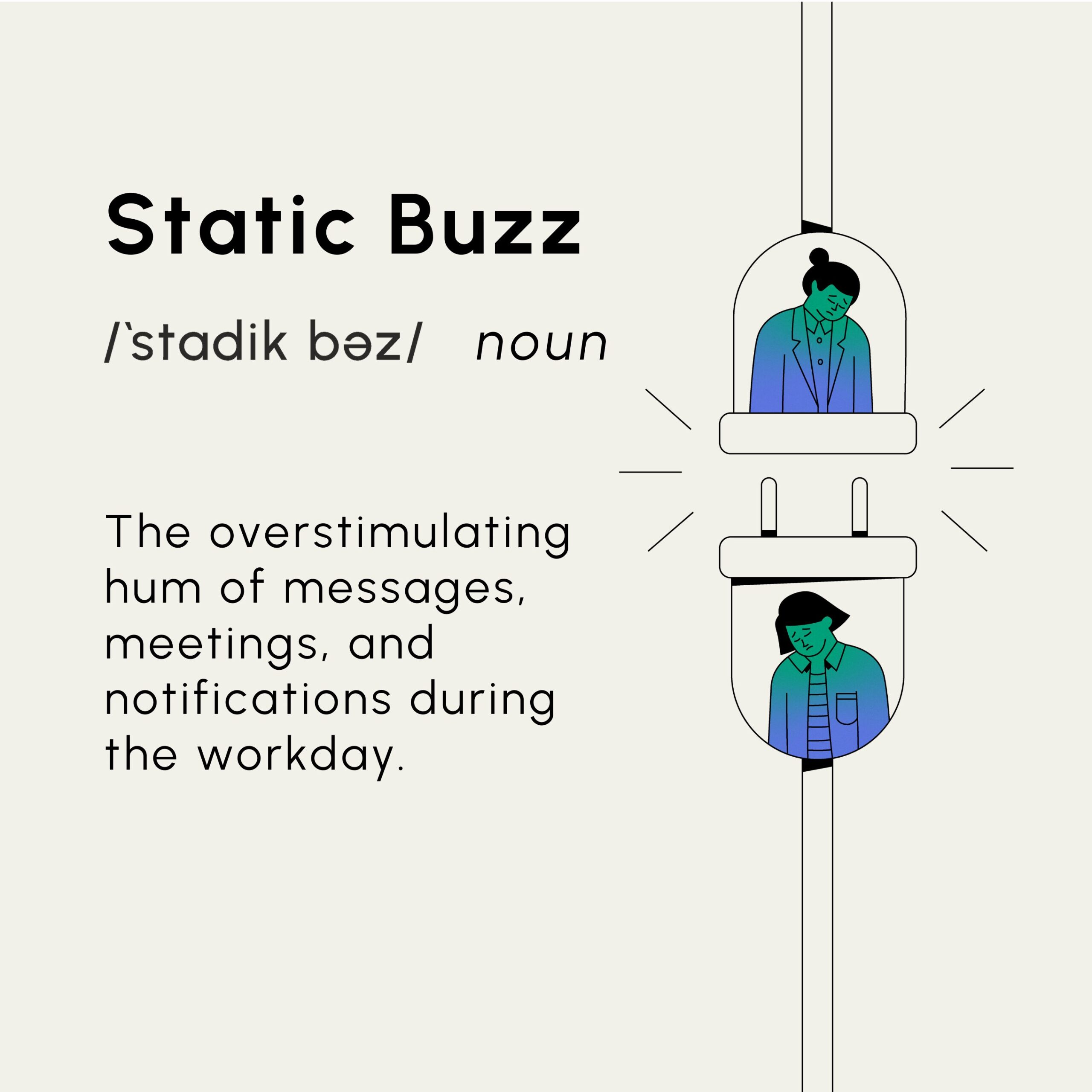
Static buzz in the workplace is the constant, low-grade overstimulation from messages, meetings, and notifications that keeps people socially busy but emotionally underfed.
It’s that end-of-day feeling of, “I’ve been ‘on’ and communicating, so why do I feel weirdly disconnected?”
At Sunny, we use “static buzz” to describe a work environment that favors interaction frequency at the expense of vibrancy (how emotionally rich those interactions feel). Instead of a few focused, energizing moments with colleagues, people move through a rapid-fire stream of pings, status updates, and back-to-back calls.
On the surface, it looks like healthy collaboration. Channels are active. Calendars are full. People are constantly “in communication.”
Underneath, the experience is very different. Employees feel overstimulated but under-supported. They’re known more as “the PM” or “the sales rep” than the human behind the title. And their Social Battery™ is running low long before the day is over.
Static buzz isn’t just a “busy stretch” at work. It’s that specific combination of always-on noise, constant task-switching, and interactions that stay shallow.
A social energy problem, not a personality problem
When people feel drained by work, it’s easy to assume they just need some “resilience training” or that they’re simply introverted.
At Sunny, we see it as a design issue: how we’ve structured time, tools, and expectations is quietly draining social energy (the fuel we rely on to collaborate, care, and create together).
When static buzz becomes the norm:
- Employees’ Social Battery™ wears down faster and recharges more slowly.
- They feel “peopled out” without ever having had a truly human moment.
- Leaders mistake visible activity (“We always talk!”) for real connection (“We feel close and energized”) and miss the early signs of burnout at work.
In short: static buzz is what work feels like when communication keeps ramping up, but meaningful connection doesn’t.
So, how did we end up here?
Why static buzz is increasing at work
Leaders didn’t wake up one day and say, “Let’s make work feel noisy but empty.” What actually happened is more subtle. Over time, many sensible choices (optimize for efficiency, move faster, adopt “better” tools) pushed work toward speed and output and away from vibrancy, shared focus, and real human contact.
That 4:37 p.m. feeling is the predictable result of how we’ve been building our days. A few patterns show up again and again:
1. Work is optimized for efficiency, not connection
Most communication is short and transactional (“Quick update…”, “Can you send X?”). Performance systems reward individual productivity over shared wins. And “empty” calendar time gets treated as something to fill, not something to protect for recovery or connection.
On a dashboard, all of that looks impressive. But in practice, it creates a workday that feels thin and rushed.
2. Digital tools have multiplied the noise
We’ve layered digital tools (Slack, email, project boards) on top of each other. The average employee is interrupted every two minutes and toggles between 11+ applications per day. What starts as “better collaboration” becomes an attention bottleneck: people are always “on,” but rarely fully present.
3. Hybrid work and “always on” culture
Hybrid and remote work changed where we work, but most organizations never updated how people connect.
Hallway chats and spontaneous check-ins have been replaced by scheduled touchpoints and video calls, often leading to “Zoom fatigue”. Plus, the subtle pressure to prove you’re online keeps people tethered to their devices.
Even in offices, headphones, full calendars, and split attention recreate the same distance. Being physically close doesn’t guarantee you feel close at all.
4. A workforce hungry for more
The static is building against a backdrop of rising disconnection: 41% of Americans say they feel lonely, and younger workers in particular are craving work that feels relational and purposeful.
So there’s a workforce hungry for meaningful connection sitting inside systems that deliver more static. That gap is where disengagement and burnout start to grow.
How static buzz impacts employees and teams
By the end of the day, calendars show hours of ‘teamwork’, but people’s minds and bodies register exhaustion and distance. That’s static buzz in action. It doesn’t look like one big crisis; it’s a slow leak that drains the Social Battery™, changing how—and if—people show up for each other.
The drain is as much about focus as it is feelings. Every notification forces a micro-switch in attention: research suggests it can take around 23 minutes to fully refocus after each digital interruption. People close their laptops thinking, “I was busy all day…so why is half my to-do list still untouched?” Eventually, employees stop reaching out; not because they don’t care, but because every interaction feels like one more thing they don’t have the energy for.
When enough people feel this way, the whole team pays for it. It becomes riskier to say “I’m stuck,” “I don’t know,” or “I see this differently,” so collaboration gets shallower and innovation slows. On paper, activity is high. Underneath, the team is quietly stagnating.
How leaders unintentionally contribute to static buzz
Here’s the tricky part: static buzz often thrives in teams with leaders who care deeply and are trying to do the right thing. But in the push for productivity, well-meaning managers unintentionally design workflows that favor constant activity over meaningful connection.
Common patterns include:
1. Equating volume with connection
Most leaders want to be supportive, so they increase touchpoints: more check-ins, more messages, more meetings. But that boosts frequency, not vibrancy.
It’s easy to mistake jam-packed calendars for a truly connected team. In reality, it’s just a schedule that fries the Social Battery™ before the conversations that matter even begin.
2. Leaving tools and norms undefined
When new platforms roll out with “Use what works for you,” every message becomes a small decision. Email or Slack? Urgent or FYI? Project board or doc?
People hedge when they’re not sure. They post the same update in three places and reply, “just in case.” Multiply that across a team, and you get exactly what static buzz feeds on: endless notifications and the persistent worry you’re missing something important.
3. Modeling “always on” instead of sustainable energy
Leaders can say “Please disconnect,” but if they’re firing off weekend messages and replying instantly at all hours, the real message is clear: always be available. When quick responsiveness is praised over thoughtful, sustainable work, static buzz gets louder.
How to reduce static buzz in the workplace
If static buzz is a design problem, it’s also a design opportunity. You don’t have to scrap your operating model. Small, simple shifts can turn the same workday into less static and more meaning.
1. Run a “noise audit” and make 2–3 clear changes
Before adding anything new, dial down the noise. Spend a week or two observing your team’s communication patterns:
- Map your communication load. List meetings, channels, and notification sources. Ask, “If we canceled this for a month, what would actually break?”
- Spot the noise. Notice what’s redundant (same topic in three meetings), low-value (status updates that could be async), or intrusive (notifications that constantly interrupt deep work).
- Agree on 2-3 experiments. For example: uninterrupted focus blocks; shortened meetings; simple channel rules (“Urgent = this channel, FYI = that channel”).
2. Build “more vibrancy, more often” into existing time
Once the static is dialed down, upgrade the interactions you already have. No extra social hours required; just small, repeatable rituals:
- Start meetings with a quick human check-in: “What’s one word to describe your morning?”
- Swap “How’s it going?” for something more specific: “What’s one thing that’s helped you recharge lately?”
- Weave in specific appreciation: “Because of you, X was easier this week.”
3. Make social energy visible
Static buzz fades when social energy becomes a metric your team talks about. Start with a light pulse in 1:1s or team syncs:
- “How energized do you feel heading into this week?”
- “How confident do you feel reaching out to teammates when you’re stuck?”
- “How would you describe the ‘vibe’ on our team this week?”
Share the feedback and co-design tiny experiments with your team, like pairing up on tough tasks or scheduling high-collaboration work when energy is high.
Bringing it all together
Static buzz in the workplace won’t disappear overnight. But with intentional shifts, you can reduce overstimulation, invite more vibrancy, and create an environment where people feel seen, energized, and able to do their best work together.
When you clear the static, real human connection can finally come through. And that 4:37 p.m. moment starts to feel different. Instead of ending the day in a scrambled blur, your Social Battery™ feels used with intention on the people and work that actually matter.
If you want to go deeper into how static buzz, social energy, and the Social Battery™ are shaping today’s workplaces, check out Sunny’s Energized by Design white paper. You’ll find that, plus more tools and resources, at gosunny.org.nd Facebook @gosunny.org.