Article
Team building alternatives that actually build culture (not just fill a calendar)
Key takeaways
- Traditional team building fails because 60% of employees find it embarrassing, and it treats culture as an event rather than a practice.
- Managers account for 70% of engagement variance, making daily behaviors the most powerful culture-building tool available.
- Small, repeated rituals in the flow of work produce measurable culture change that single events cannot.
- Science-backed modern team building focuses on psychological safety and behavioral patterns, not activities.
- Organizations that changed everyday behaviors saw a 26% trust increase, while 72% of formal culture initiatives showed no improvement.
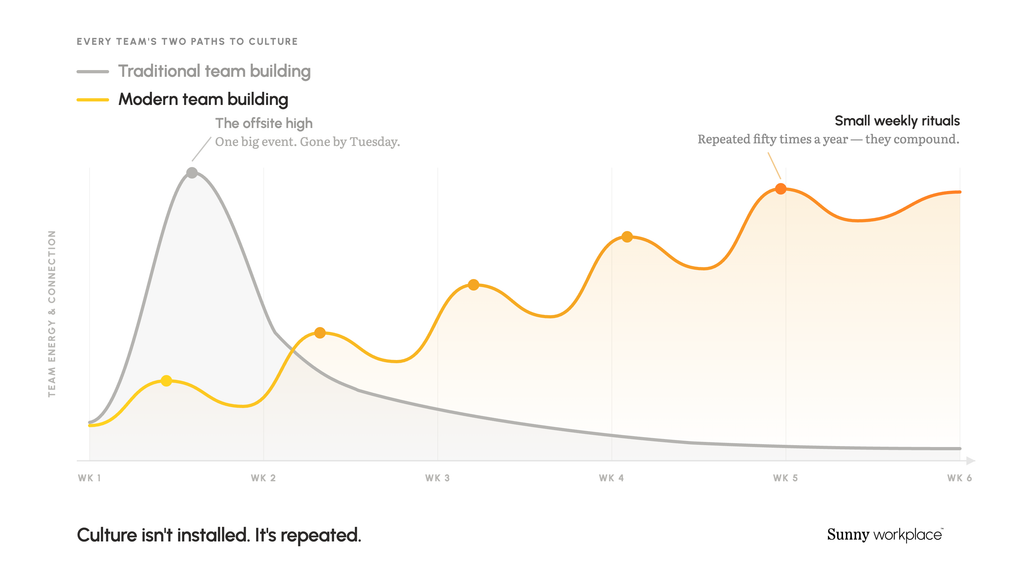
Your team came back from the offsite on Friday buzzing. People were laughing in the elevator, referencing inside jokes from the ropes course, tagging each other in Slack with photos from dinner. By Tuesday, the energy had evaporated. The same stilted standup. The same camera-off calls. The same silence after “any questions?”
This is the Tuesday problem, and almost every organization has it. Microsoft’s 2025 Work Trend Index found that Tuesdays carry the heaviest meeting load at 23% of the weekly total, making them the day teams feel the most squeezed, the least spontaneous, and the most like they’re just getting through it. If your culture can’t survive a Tuesday, it doesn’t actually exist yet.
The good news: building real culture doesn’t require another offsite budget line. It requires changing what happens in ordinary moments, the ones that repeat fifty times a year instead of once.
Why traditional team building doesn’t work (and everyone knows it)
The cringe factor is real
You already know the feeling. The icebreaker where everyone shares their “spirit animal.” The escape room that three people dominate while the rest stand back. The happy hour that’s only fun for the extroverts.
A 2025 YouGov survey confirmed what most employees already suspected: 60% find traditional team building activities embarrassing. That number rises for introverts, neurodiverse employees, and anyone who processes connection differently than a group scavenger hunt demands.
Forced fun isn’t connection. It’s performance. And when people feel like they’re performing rather than participating, trust actually decreases. The impact of workplace loneliness compounds when artificial social events fail to create genuine belonging.
Culture initiatives that change nothing
Here’s the part that should concern HR leaders more than the cringe factor: it isn’t working. Research published in Harvard Business Review (2025) found that 72% of culture-improvement initiatives showed no measurable improvement in team trust, collaboration, or engagement scores twelve months later.
The reason is structural, not intentional. Most initiatives treat culture as something you install (a value statement, a quarterly event, a new Slack channel) rather than something teams practice daily. The same research found that the organizations seeing results, a 26% increase in trust, were the ones that changed everyday team behaviors rather than launching programs.
Culture isn’t installed. It’s repeated.
What are the alternatives to traditional team building?
The best alternatives to traditional team building are daily and weekly practices embedded in the flow of work, not alternative activities. Instead of replacing the escape room with a cooking class, effective organizations replace the event-based mindset entirely by building connection, recognition, and psychological safety into meetings, one-on-ones, and team communication that already happens. A science-backed team building approach focuses on these behavioral patterns rather than one-off events.
The manager is the culture
Why your manager matters more than your mission statement
Ask someone what their company’s values are, and they’ll probably pull up a poster. Ask them what their team’s culture feels like, and they’ll describe their manager.
Gallup’s research consistently shows that managers account for 70% of the variance in team engagement. That single data point reframes the entire conversation: culture isn’t a company-level initiative. It’s a manager-level behavior, repeated weekly.
The stakes are higher than most organizations realize. Perceptyx’s 2026 State of the Manager report found that 24% of employees say they are currently working for the worst manager they’ve ever had. Meanwhile, Gallup’s 2024 data shows employees who feel connected to their organization’s culture through their manager are four times more likely to be engaged.
The implication is clear. You can spend six figures on a culture initiative, or you can give managers five specific behaviors that cost nothing and compound weekly.
Five manager behaviors that replace any offsite
- Start meetings with a real question. Not “how was your weekend?” but something that invites genuine thought. “What’s one thing that went better than expected this week?” or “What’s taking more energy than it should right now?” These questions signal that the person matters, not just their output.
- Make invisible contributions visible. Most recognition happens for finished deliverables. The teammate who unblocked someone else, who rewrote a confusing doc, who covered a shift without being asked. Those contributions vanish unless a manager names them. Do it in a team channel. Do it in a meeting. Specificity is what makes it land.
- End one-on-ones with a forward look. Instead of ending with “anything else?” close with “what are you looking forward to this week?” or “what would make next week feel different from this one?” This shifts the final emotional note from administrative to human.
- Narrate your thinking aloud. When managers explain why they made a decision, not just what the decision was, it builds psychological safety. People learn that disagreement is possible because the reasoning is visible. “I went with Option B because of X and Y, but I was genuinely torn. What am I missing?”
- Friday five-minute reflection. Before the weekend, ask the team (async or live): “What’s one thing we did well together this week?” Five minutes. No agenda item. Just a consistent beat that says: we notice what we build, not just what we ship.
None of these require budget approval. All of them compound over time.
Building meaningful connection in the flow of work
Meeting rituals that build trust without building agendas
The simplest culture interventions live inside meetings that already exist. They don’t require new calendar invites or additional time. They require new first minutes. Research shows connected teams perform highest when connection is woven into everyday interactions rather than siloed into special events.
The two-minute opener. Start any recurring meeting with a lightweight prompt that invites something real: “What’s giving you energy this week?” or “What changed since we last talked?” Two minutes maximum. The prompt rotates. Over time, this builds a pattern where people arrive expecting to be seen as humans, not just contributors.
The perspective round. Before finalizing any decision, encourage people to share one of three things: a concern they have, something they’re genuinely excited about, or one thing they’d change if they could. This simple practice surfaces disagreement before it turns into resentment later.
The “what are we not saying?” check-in. Midway through any decision-heavy meeting, pause and ask: “What’s the thing we’re all thinking but not saying out loud?” Give fifteen seconds of silence. Someone will fill it. This question surfaces the unspoken tensions that derail execution later, and it signals that honesty is more valuable than politeness.
Peer connection without forced fun
Skill swaps. Pair two people who want to teach each other something for thirty minutes every two weeks. One person teaches pivot tables, the other teaches presentation design. The connection is the byproduct of the learning, not the stated objective. Understanding why friends at work matters helps explain why these organic interactions outperform structured social events.
Collaborative real problem-solving. Instead of hypothetical team challenges, bring an actual stuck problem to the group: “This client renewal is stalling. Can three of you spend twenty minutes with me on it?” Real problems create real interdependence.
Async appreciation. A weekly thread (in Slack, Teams, or wherever your team lives) with one prompt: “Who helped you this week, and how?” No requirement to post. No gamification. Just a consistent space where gratitude has a home.
How to know it’s working (without another survey)
Gallup’s 2026 data found that 80% of employees are not engaged, despite the fact that engagement surveys have never been more widespread. The measurement isn’t the problem. The gap between measurement and action is.
Annual surveys tell you the score. They don’t tell you what changed on a given Tuesday. They don’t capture whether the new meeting ritual landed or whether last week’s recognition felt forced.
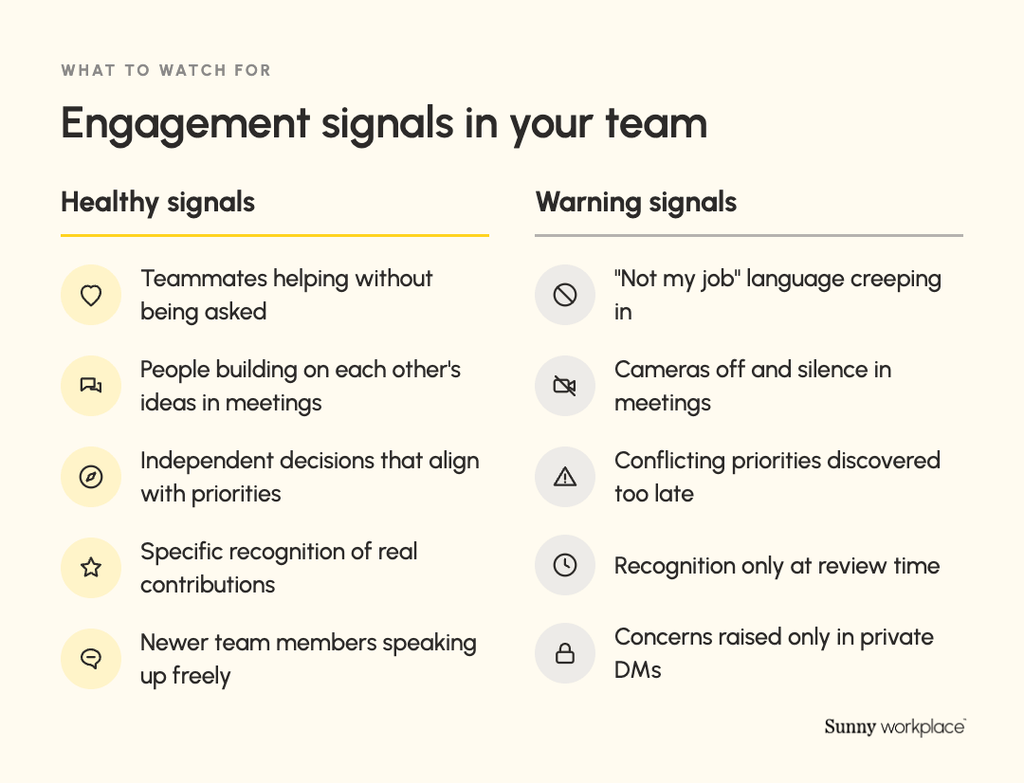
Behavioral signals matter more than survey scores. Look for: Are more people speaking in meetings? Are one-on-ones running their full time instead of ending early? Are people volunteering for cross-functional work? Are managers asking different questions?
Making the shift: from events to everyday
Rebalancing doesn’t mean eliminating offsites or team events entirely. It means shifting the ratio. Think 80/20: 80% of your culture investment goes into everyday behaviors, weekly rituals, and manager capability. 20% goes into events that celebrate and reinforce what’s already being built.
Here’s how to start:
- Pick one team. Don’t roll out a company-wide initiative. Choose a willing team and pilot two or three of the practices above for six weeks.
- Give managers conversation guides. Most managers want to build better culture. They lack specific language. Provide the questions, prompts, and rituals ready to use. No training required, just something they can run in their next meeting.
- Set expectations on timeline. Culture change that sticks is visible in six to eight weeks, not six to eight days. Communicate that to leadership early. The Friday buzz from an offsite fades by Tuesday. The Tuesday ritual that runs every week builds something that lasts.
- Measure behavior, not just sentiment. Track participation in rituals, one-on-one completion rates, and whether teams are using the prompts. These leading indicators move before engagement scores do. Organizations that focus on ways to improve employee well-being through everyday practices see results compound over time.
Culture isn’t an offsite. It’s a Tuesday.
Come back to that Friday after the offsite. The energy, the laughter, the sense that this team is something worth belonging to. That feeling was real. The mistake was assuming it needed a special occasion to exist.
Culture lives in the ordinary. In the question a manager asks at 9:15 on a Tuesday morning. In the five seconds a teammate takes to recognize someone’s invisible work. In the consistent rhythm of a team that notices each other, not just once a quarter, but every single week.
Next Tuesday, try one thing differently. One real question. One moment of visible recognition. One prompt that invites something human into a meeting that usually doesn’t leave room for it.
The offsite didn’t build your culture. But next Tuesday might.
FAQ
What are the best alternatives to traditional team building?
The most effective alternatives are not alternative activities (swapping an escape room for a cooking class). They are daily and weekly practices built into the flow of work: meeting openers that invite genuine sharing, peer recognition rituals, manager-led reflection prompts, and skill swaps. These create consistent, low-effort connection rather than occasional, high-effort events.
Why do employees dislike team building activities?
Research shows 60% of employees find traditional team building embarrassing (YouGov, 2025). The core issue is that forced participation in performative group activities, particularly those that favor extroverts, creates pressure rather than connection. Employees want to feel seen and valued in the context of their actual work, not in artificial scenarios disconnected from it.
How can managers build culture without events?
Managers build culture through five repeatable behaviors: asking real questions (not just status updates), recognizing invisible contributions publicly, ending one-on-ones with a human-centered forward look, narrating their decision-making process, and facilitating brief weekly reflections. These daily behaviors account for far more engagement variance than any quarterly event.
What is modern team building?
Modern team building embeds connection, recognition, and psychological safety into the flow of work rather than treating them as separate events. It focuses on behavioral patterns (weekly rituals, meeting design, manager behaviors) rather than activities, and measures impact through real-time team-level signals rather than annual surveys alone.