Press Release
Lost in translation
New poll: 4 in 5 Gen Z workers find workplace language gap a challenge
Press Release
July 2026
Lost in translation: 4 in 5 Gen Z workers find workplace language gap a challenge
Poll marking National Intern Day (July 30) finds Gen Z workers are nearly three times as likely as Boomers to experience generational language challenges at work
DALLAS (July 16, 2026) Four out of five Gen Z workers say generational differences in workplace language and communication style are a challenge, according to a new poll of U.S. workers to mark National Intern Day (July 30).
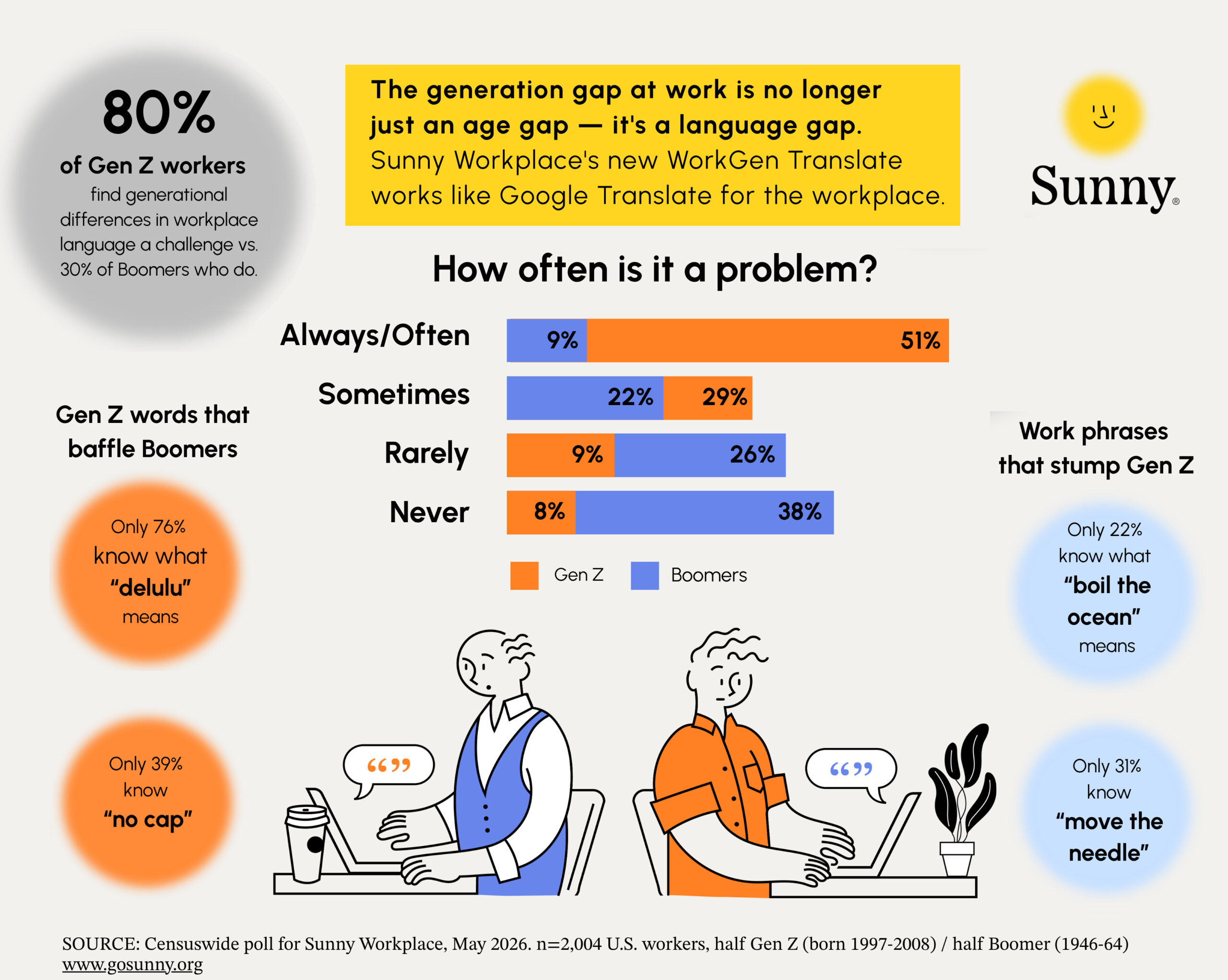
Gen Z workers are nearly three times as likely as Boomers to have experienced such challenges in the past month (80% vs. 30%), finds the independent national poll of 2,004 U.S. workers conducted by Censuswide for Sunny Workplace, a new team performance and engagement platform. The sample was half Gen Z, half Boomer.
Sunny Workplace commissioned the survey to mark both National Intern Day and the launch of WorkGen Translate, a lighthearted new AI translation tool designed to bridge the generational language gap at work (or at least reduce the time wondering what on earth that last Slack message meant).
Over half (51%) of Gen Z workers polled find the workplace language gap a challenge “Always” or “Often”, compared to just 9% of Boomers. Just 8% of Gen Z say they “Never” face such challenges, versus almost 4 in 10 Boomers (38%).
“The findings point to a practical challenge for HR leaders,” says Dr. Iain Smith, occupational psychologist and Head of Behavioral Science at Sunny Workplace. “Small differences in tone, shorthand and workplace language can soon affect collaboration, belonging and trust.”
He adds: “Language may be the most obvious and entertaining, but it’s only one piece of the puzzle. Generational differences can also show up in expectations, working styles, tech habits, feedback preferences and how people interpret urgency.”
WorkGen Translate works like an amusing Google Translate for workplace communication. It helps workers understand messages from colleagues of different generations and draft replies in language that lands with the intended audience.
Sunny Workplace stresses that WorkGen Translate is a light-hearted tool, designed for fun, enjoyment and the occasional “ohhh, that’s what they meant” moment.
Not sure what a Gen Z colleague means? Or how to phrase a message for someone from another generation? Users can paste an email, Slack or Teams message into WorkGen Translate and translate it into the language of their own generation or the one they’re trying to reach.
If a Gen Z worker declares, “No cap, this meeting was mid,” WorkGen Translate helps their Boomer colleague understand that what they meant is, “This meeting was average, to be honest.” And if a manager says, “Let’s not boil the ocean,” WorkGen Translate translates: “Let’s not overcomplicate this.”
WorkGen Translate is bridging the workplace language gap, one ‘circle back’ at a time. Today’s workplace spans five generations, where “no cap,” “honestly,” and “to be perfectly candid” can all live in the same meeting. It’s a playful reminder that clearer communication starts with better understanding.
“If colleagues came with subtitles, a lot of workplace friction would disappear overnight,” says Dr. Smith.
Poor workplace communication already costs U.S. businesses an estimated $1.2 trillion a year, according to a 2022 study, The State of Business Communication, conducted by Harris Poll for Grammarly, the writing software company. The new poll by Sunny Workplace suggests new differences in generational language could contribute to those communication challenges.
The poll findings also land at a time when U.S. employee engagement remains under pressure. Gallup says engagement among U.S. workers averaged 31% in 2025, down from 36% in 2020, with younger workers experiencing the biggest drops. It links the decline to basic workplace needs such as clearer communication, role clarity and respect.
The new poll also asked Gen Z workers how familiar they were with a list of common workplace expressions used by more experienced colleagues.
The phrase least likely to translate was “boil the ocean”, meaning to attempt something unnecessarily complicated or impossible. Only 22% of Gen Z workers say they know exactly what it means, while more than half (53%) say they’re unfamiliar with it.
“Blue-sky thinking”, creative brainstorming without practical limits, also stumps many Gen Z workers. Just a quarter (25%) know exactly what it means, while fewer than one in three (31%) say the same of “move the needle,” meaning to make a meaningful difference or measurable progress.
And it works both ways. “Delulu,” “rizz” and “no cap,” meanwhile, topped the list of Gen Z terms that baffle Boomers.
Three-quarters of Boomer workers (76%) “have no idea” what “delulu” means, Gen Z-speak for being unrealistic or kidding yourself. Two-thirds (66%) say the same of “rizz”, meaning natural charm or charisma, and 61% do so of “no cap,” meaning honestly/no lie.
“A language gap can look just like an attitude problem, even when it isn’t one,” says Dr. Smith. “A colleague who sounds blunt to one generation may sound clear and efficient to another.”
While WorkGen Translate is meant as a playful tool, it points to a more complex workplace challenge: employee engagement. Sunny Workplace’s flagship platform helps managers and HR leaders build connected, high-performing teams by embedding modern team building into the flow of work. Its Team Vitals dashboard tracks in real time how team members feel supported, energized, aligned, recognized and safe.
“The best teams don’t need everyone to speak the same way,” says Dr. Smith. “But they do need everyone to understand what others are trying to say.”
PRESS CONTACT
NOTES FOR EDITORS
Methodology:
The research was conducted by Censuswide among a sample of 2,004 adults aged 18+ in the U.S. workforce. Half were Gen Z workers, born 1997–2008, and half were Boomers, born 1946–1964. Data was collected May 25-26, 2026. Censuswide is a member of the Market Research Society and a signatory of the Global Data Quality Pledge, which adheres to the MRS Code of Conduct and ESOMAR principles.
Respondents were asked the question: “In the past month, how often, if at all, have differences in language, expressions, communication style and/or tone between Gen Z workers and other generations presented a challenge in your workplace?”
ABOUT WORKGEN TRANSLATE
Sunny Workplace stresses that WorkGen Translate is a light-hearted, intergenerational translation tool designed for fun and enjoyment, not something to rely on for anything important, sensitive or business-critical. Users should NOT use WorkGen Translate for communications where precision, legal accuracy or serious consequences are involved, and Sunny Workplace accepts no responsibility for outcomes arising from its use.
Users choose what text to enter into WorkGen Translate, which is not designed to monitor employees, score individuals or require workers to communicate in any particular way. Sunny Workplace advises users not to enter confidential, legally privileged, sensitive personal or commercially sensitive information unless permitted by their employer and covered by appropriate data-processing arrangements.
WorkGen Translate is not a professional communication service, and its outputs should be treated accordingly. Sunny Workplace can provide further information on WorkGen Translate’s privacy, security and data-handling approach on request.
ABOUT SUNNY WORKPLACE
Sunny Workplace builds high-performing, engaged teams by embedding modern team building into the flow of work. By giving HR leaders a real-time view of Team Vitals, it helps them understand what teams need now and turn engagement insights into weekly team actions that boost communication, strengthen culture and increase engagement. Engagement surveys tell you the score. Sunny Workplace helps you act on it.